
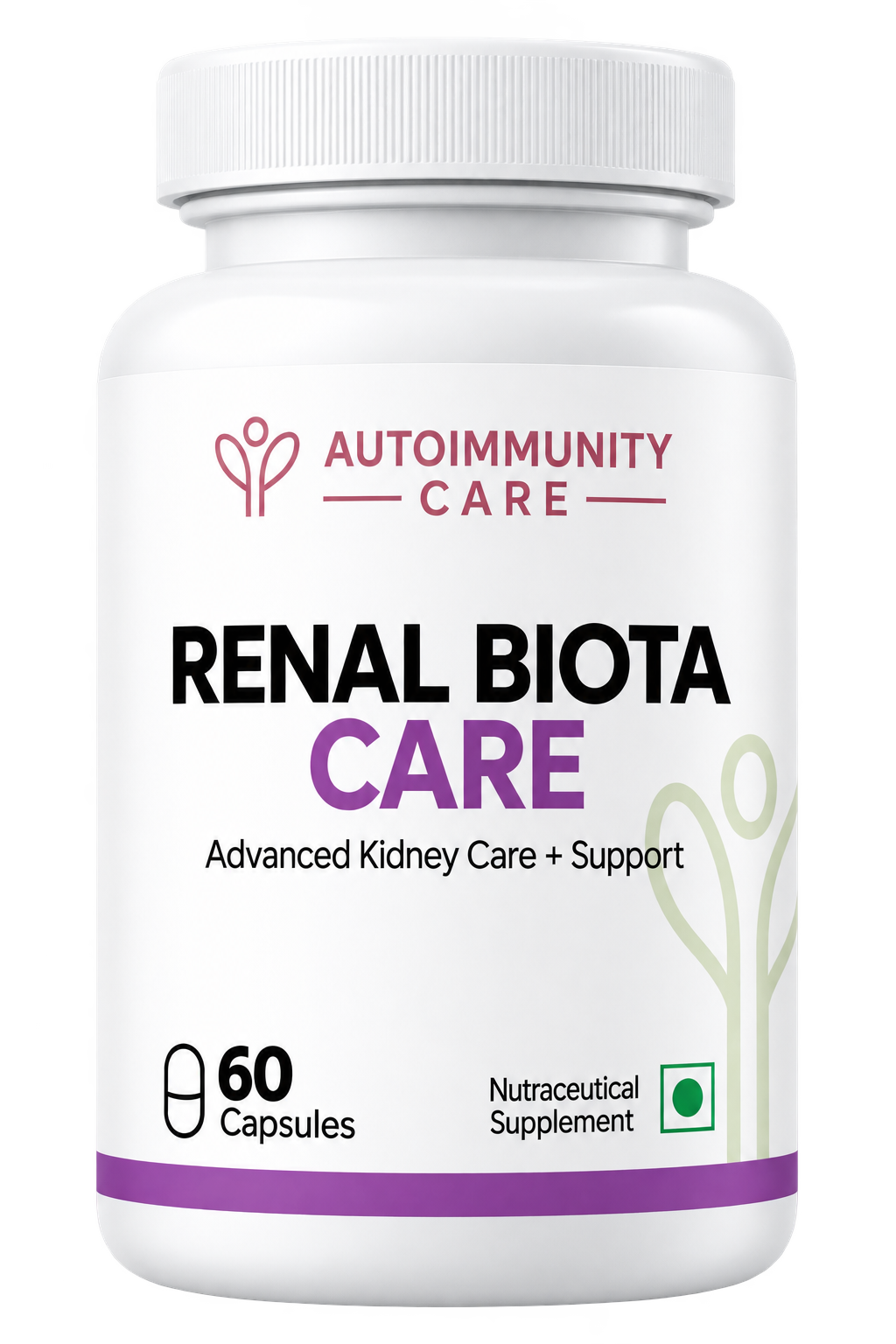
Autoimmunity Care Renal Biota Care
₹1,395
MRP (incl. of all taxes)
100 Billion CFU | 9-Strain Gut-Kidney Axis Probiotic | CKD · Uremic Toxins · Renal Inflammation · Gut Barrier
Renal Biota Care delivers 100 Billion CFU across 9 clinically selected probiotic strains — formulated specifically for the gut-kidney axis. It targets uremic toxin reduction, oxalate metabolism, endotoxin load, phosphorus metabolism and renal inflammation — addressing the gut as the primary driver of CKD progression.
With Akkermansia, Clostridium butyricum and targeted Bifidobacterium and Lactobacillus strains, this is India’s most clinically precise probiotic for kidney health support.
Doctor formulated. Clinically dosed.



Our Certification
Transformative Experience – Exceeded All Expectations!






Honest Products. Superior Quality
Our Products are made with care
 No Pesticides
 Gluten Free
 No Artificial Colors
 GMO Free
 Vegan Options
 Additive Free
 Dairy Free
 Soy Free
 Sugar Free
How will Autoimmunity Care Renal Biota Care benefit you
- Clears Kidney Toxins
- Strengthens Gut Barrier — Stops Toxin Translocation
- Lowers Uremic Load
- Balances Acid Levels
- Protects Kidney Function
- Reduces Renal Inflammation
- Resets Metabolism & Immunity
- Improves Mood & Reduces Anxiety in CKD
- Restores Mucosal Immunity
This Is For You If
- You have been diagnosed with Chronic Kidney Disease (CKD) — Stage 1-4
- You have elevated creatinine, urea, uric acid or uremic toxin markers
- You have high urinary oxalate or a history of calcium oxalate kidney stones
- You have gut dysbiosis, leaky gut or chronic constipation alongside kidney disease
- You are on dialysis or pre-dialysis and want gut-based toxin reduction support
- You have CKD-related inflammation, fatigue, brain fog or mood disturbance
- You have phosphorus metabolism concerns or elevated inflammatory markers
- You are a functional medicine practitioner managing CKD patients with a gut-first approach
- You want comprehensive gut-kidney axis support as part of a root-cause renal health protocol
Building The Foundation Of Health + Nutrition
World-Class Quality + Finest Ingredients
Science-driven natural ingredients to deliver daily healthy fats, anti-inflammation & anti-oxidants.
Bifidobacterium Longum
Reduces indoxyl sulfate & p-cresol; gut barrier; mood & anxiety in CKD
Lactobacillus Plantarum
Decreases oxalate absorption; reduces TNF-α & IL-6; improves lipid profile
Bifidobacterium Bifidum
Lowers endotoxin load; reduces kidney inflammatory burden; restores mucosal IgA
Lactobacillus Acidophilus
Decreases urea & nitrogenous waste; improves digestion
Pediococcus Acidilactici
Suppresses toxin-forming microbes; improves phosphorus metabolism
Bacillus Coagulans
Reduces inflammation; improves bowel regularity for toxin elimination
Pasteurized Akkermansia Muciniphila
Strengthens mucin layer; reduces endotoxin crossing; improves glucose control
Lactococcus Lactis
SCFA production; restores tight junctions; reduces leaky gut-driven kidney injury
Clostridium Butyricum
Butyrate production — reduces systemic inflammation, protects kidney epithelial cells, improves mitochondrial function in renal tissue
 1–2 capsules at night (2 hours after dinner) or empty stomach
Product Description
Revolutionize Your Daily Grind with Cutting-Edge Innovation
RENAL BIOTA CARE
100 Billion CFU | 9-Strain Gut-Kidney Axis Probiotic | CKD · Uremic Toxins · Renal Inflammation · Gut Barrier
What Is It
Renal Biota Care is a precision probiotic formulation developed specifically for the gut-kidney axis — the bidirectional relationship between gut microbiome health and kidney function that is now recognised as central to CKD progression, uremic toxin burden and renal inflammation.
In chronic kidney disease, gut dysbiosis drives the production of uremic toxins — indoxyl sulfate, p-cresol, urea and endotoxins — that directly damage kidney tissue, accelerate inflammatory injury and worsen outcomes. Standard CKD management rarely addresses this gut-kidney connection. Renal Care does.
Nine strains. 100 Billion CFU. Each strain chosen for a specific, clinically documented role in reducing uremic toxin production, lowering renal inflammatory burden, improving oxalate and phosphorus metabolism, strengthening the gut barrier and protecting kidney epithelial cells.
Not a generic probiotic adapted for kidney health. A formula built from the ground up for it.
This Is For You If
- You have been diagnosed with Chronic Kidney Disease (CKD)
- You have elevated creatinine, urea, uric acid or uremic toxin markers
- You have high urinary oxalate or a history of calcium oxalate kidney stones
- You have gut dysbiosis, leaky gut or chronic constipation alongside kidney disease
- You are on dialysis or pre-dialysis and want gut-based toxin reduction support
- You have CKD-related inflammation, fatigue, brain fog or mood disturbance
- You have phosphorus metabolism concerns or elevated inflammatory markers
- You are a functional medicine practitioner managing CKD patients with a gut-first approach
- You want comprehensive gut-kidney axis support as part of a root-cause renal health protocol
What Changes & When
Week 1–2
Bowel regularity improves — critical for uremic toxin elimination. Gut dysbiosis begins to shift. Bloating and digestive discomfort reduce. Early reduction in endotoxin-driven systemic symptoms.
Week 3–4
Uremic toxin production begins to decrease as toxin-forming gut microbes are suppressed. Gut barrier integrity improves. Systemic inflammation markers start to shift. Mood and anxiety may improve as gut-brain signalling stabilises.
Week 6–8
Measurable reduction in indoxyl sulfate, p-cresol and urea production. Oxalate absorption reduces. Phosphorus metabolism improves. Butyrate production increases — protecting kidney epithelial cells and reducing renal inflammatory burden.
3 Months+
Sustained gut-kidney axis improvement. Uremic toxin burden meaningfully lower. Gut barrier sealed. Renal inflammatory injury reduced. CKD progression support established as part of a comprehensive protocol.
Dosage & Rationale
1–2 capsules at night (2 hours after dinner) or empty stomach, daily or as directed by your healthcare practitioner
Why this specific strain combination?
Every strain in Renal Care was selected for a documented, specific role in the gut-kidney axis — not for general probiotic benefit. The combination addresses all major gut-driven drivers of CKD progression simultaneously: uremic toxin production, oxalate absorption, endotoxin load, phosphorus metabolism, gut barrier integrity, butyrate production and renal inflammatory signalling.
Why 100 Billion CFU?
CKD is associated with severe gut dysbiosis — a significantly altered microbiome with reduced beneficial bacteria and increased toxin-producing species. Restoring meaningful microbial balance in this context requires a high CFU count. 100 Billion CFU across 9 targeted strains provides the microbial volume needed to shift the gut-kidney axis measurably.
Why Pasteurized Akkermansia?
Live Akkermansia is difficult to stabilise in oral supplementation. Pasteurized Akkermansia retains the key bioactive proteins — particularly Amuc_1100 — responsible for its gut barrier and anti-inflammatory effects, without requiring live cell viability. This is the clinically studied form.
Best taken: Before sleep — allows overnight colonisation during the gut’s repair phase.
Loading period:
1–2 weeks for bowel regularity and digestive improvement · 4–6 weeks for uremic toxin reduction and gut barrier improvement · 3 months for sustained gut-kidney axis benefit
The Gut-Kidney Axis — Why It Matters
The gut and kidneys are in constant bidirectional communication. In healthy individuals, the gut microbiome metabolises dietary proteins and fibres into beneficial compounds — SCFAs, butyrate — while limiting the production of uremic toxins.
In CKD, this balance breaks down:
- Gut dysbiosis → overgrowth of toxin-producing bacteria
- Increased production of indoxyl sulfate, p-cresol, urea — uremic toxins that directly damage kidney tubular cells
- Leaky gut → endotoxin (LPS) enters systemic circulation → amplifies renal inflammation
- Reduced butyrate production → gut lining weakens → more toxin translocation → faster CKD progression
This is a vicious cycle. Renal Care interrupts it at every point — reducing toxin-producing bacteria, strengthening the gut barrier, boosting butyrate production and directly lowering the uremic toxin burden on the kidneys.
Safety & Interactions
Generally well-tolerated at recommended doses. Use under practitioner guidance for CKD — especially in advanced stages or dialysis.
Potassium content: Some probiotic fermentation products may influence potassium levels. In advanced CKD with hyperkalemia, monitor potassium status under practitioner guidance.
Phosphorus metabolism: Pediococcus acidilactici improves phosphorus metabolism — monitor phosphorus levels if on phosphate binders.
Dialysis patients: Renal Care may be used as adjunct support alongside dialysis under nephrologist supervision. It does not replace dialysis or prescribed renal medications.
Immunocompromised patients: High-CFU probiotics in severely immunocompromised individuals (advanced CKD, transplant recipients) should be used under specialist supervision.
Pregnancy & lactation: Consult your healthcare practitioner before use.
Drug interactions: No known significant interactions at recommended doses. Inform your nephrologist and prescribing physician of all supplements being taken alongside CKD medications.
Disclaimer: Renal Care is a dietary supplement. It is not intended to diagnose, treat, cure or prevent any disease or replace prescribed medical treatment for chronic kidney disease. Use under the supervision of your nephrologist or healthcare practitioner. Do not discontinue prescribed renal medications without medical advice.
Natural Food Sources
Foods That Support Gut-Kidney Health & Beneficial Bacteria
Probiotic-Rich Foods (support beneficial gut strains)
- Fresh homemade curd — Lactobacillus strains, freshly made not stored
- Buttermilk (chaach) — traditionally fermented, lower histamine than aged dairy
- Idli & dosa — freshly prepared, not batter stored overnight
- Kefir — if tolerated and not contraindicated in your CKD stage
- Miso — in small amounts; monitor sodium in CKD
Note for CKD patients: Many fermented foods are high in potassium, phosphorus or sodium — which may need to be limited depending on your CKD stage and blood test results. Always confirm food choices with your nephrologist or renal dietitian.
Prebiotic Foods (feed Bifidobacterium and Lactobacillus)
- Cooked and cooled rice — resistant starch feeds Bifidobacterium
- Cooked and cooled potatoes — resistant starch, check potassium with your dietitian
- Banana — particularly slightly underripe; monitor potassium in advanced CKD
- Oats — prebiotic fibre; well-tolerated in early CKD
- Garlic & onion — FOS prebiotic; use in cooking in moderate amounts
Butyrate-Supporting Foods (feed Clostridium butyricum and butyrate producers)
- Whole grains — oats, barley, brown rice in CKD-appropriate portions
- Legumes — moong dal, masoor dal; monitor phosphorus and potassium
- Cooked vegetables — carrots, cauliflower, cabbage; kidney-friendly choices
Oxalate-Reducing Dietary Approaches (support L. plantarum’s oxalate metabolism role)
- Reduce high-oxalate foods — spinach, nuts, chocolate, beetroot
- Pair calcium-rich foods with oxalate-containing foods at meals — binds oxalate in the gut before absorption
- Adequate hydration — supports urinary oxalate dilution and excretion
Anti-Inflammatory Foods (reduce renal inflammatory burden)
- Turmeric — curcumin; anti-inflammatory, kidney-friendly in food amounts
- Ginger — anti-inflammatory, digestive support
- Omega-3 rich foods — flaxseeds, walnuts; supports lipid profile in CKD
- Extra virgin olive oil — anti-inflammatory fats, kidney-friendly
Critical note for CKD patients: Dietary management in CKD is highly individualised based on stage, blood test results and comorbidities. The food guidance above is general — always work with your nephrologist and renal dietitian for a personalised dietary plan. Potassium, phosphorus, sodium and protein intake all require specific management in CKD that varies by individual.
FAQ’s
What is the gut-kidney axis and why does it matter in CKD?
The gut-kidney axis describes the bidirectional relationship between gut microbiome health and kidney function. In CKD, gut dysbiosis drives overproduction of uremic toxins — indoxyl sulfate, p-cresol, urea — that directly damage kidney tissue and accelerate disease progression. A leaky gut barrier allows these toxins and LPS endotoxin to enter systemic circulation, amplifying renal inflammation. Addressing the gut is now recognised as a critical component of CKD management — not an optional add-on.
Can probiotics actually reduce uremic toxins?
In CKD, the gut becomes an increasingly important route for uremic toxin elimination — compensating for reduced kidney excretion capacity. Constipation in CKD patients dramatically worsens toxin accumulation and inflammatory burden. Regular bowel movements are a clinical priority in CKD management. Bacillus coagulans, Lactobacillus acidophilus and Clostridium butyricum in Renal Care specifically support bowel regularity for this reason.
Is Renal Biota Care safe for dialysis patients?
Renal Biota Care may be used as adjunct gut health support alongside dialysis under nephrologist supervision. It is not a replacement for dialysis or prescribed renal medications. Discuss with your nephrologist before starting — particularly regarding potassium and phosphorus monitoring.
How is this different from a regular probiotic?
A regular probiotic is formulated for general gut health. Renal Care is formulated specifically for the gut-kidney axis — every strain selected for its documented role in reducing uremic toxins, lowering renal inflammatory burden, improving oxalate and phosphorus metabolism or protecting kidney tissue. It is a clinically targeted formula, not a repurposed general probiotic.
Can I take Renal Biota Care with my existing kidney medications?
Generally yes — at recommended doses, no significant drug interactions are known. However, given the complexity of CKD management and the number of medications typically involved, always inform your nephrologist and prescribing physician of all supplements being taken. This is particularly important for phosphate binders, potassium-controlling medications and immunosuppressants in transplant patients.
How long before I see results?
Bowel regularity and digestive improvement: 1-2 weeks. Measurable reduction in uremic toxin burden and gut barrier improvement: 4-6 weeks. Sustained gut-kidney axis benefit and inflammatory reduction: 3 months of consistent use.
Can practitioners recommend Renal Biota Care?
Yes — Renal Biota Care is specifically designed for practitioner-guided functional medicine, nephrology and integrative medicine protocols. It is most effective as part of a comprehensive CKD management approach that includes dietary oxalate reduction, protein moderation, phosphorus management and regular monitoring of renal function markers.
Reference
Transformative Experience – Exceeded All Expectations!
-
Vaziri ND et al. (2013). Chronic kidney disease alters intestinal microbial flora. Kidney International.
https://pubmed.ncbi.nlm.nih.gov/23325083/
Demonstrated that CKD significantly disrupts gut microbiome composition — reducing beneficial bacteria and increasing toxin-producing species. Directly supports the rationale for targeted probiotic intervention in CKD management.
-
Nallu A et al. (2017). Gut microbiome in chronic kidney disease: challenges and opportunities. Translational Research.
https://pubmed.ncbi.nlm.nih.gov/27187081/
Histamine and histamine intolerance. American Journal of Clinical Nutrition.
-
Ranganathan N et al. (2010). Probiotic dietary supplementation in patients with stage 3 and 4 chronic kidney disease: a 6-month pilot scale trial in Canada. Current Medical Research and Opinion.
6-month clinical trial showing probiotic supplementation in Stage 3-4 CKD patients reduced blood urea nitrogen, creatinine and inflammatory markers — providing direct clinical evidence for probiotic use in CKD management at the stages most relevant to Renal Care users.
-
Plovier H et al. (2017). A purified membrane protein from Akkermansia muciniphila or the pasteurized bacterium improves metabolism in obese and diabetic mice. Nature Medicine. https://pubmed.ncbi.nlm.nih.gov/27892954/
Landmark study confirming that pasteurized Akkermansia retains full bioactive potency — improving gut barrier integrity, reducing endotoxin translocation and improving glucose metabolism. Directly supports the use of pasteurized Akkermansia in Renal Care over less stable live forms.
-
Rossi M et al. (2012). Synbiotics easing renal failure by improving gut microbiology (SYNERGY). BMC Nephrology.
Clinical trial demonstrating that synbiotic supplementation measurably reduced uremic toxin burden and improved gut microbiome composition in CKD patients — validating the combined probiotic approach used in Renal Care.
-
Nakabayashi I et al. (2011). Effects of synbiotic treatment on serum level of p-cresol in haemodialysis patients. Nephrology Dialysis Transplantation.
https://pubmed.ncbi.nlm.nih.gov/21059739/Showed significant reduction in serum p-cresol levels — a major uremic toxin — following Bifidobacterium-containing synbiotic supplementation in dialysis patients. Directly supports the 25 Billion CFU B. longum dose as the highest-priority strain in Renal Care.
-
Campieri C et al. (2001). Reduction of oxaluria after an oral course of lactic acid bacteria at high concentration. Kidney International. https://pubmed.ncbi.nlm.nih.gov/11380828/
Demonstrated that high-concentration Lactobacillus supplementation significantly reduced urinary oxalate excretion — supporting L. plantarum’s role in Renal Care for oxalate metabolism and kidney stone risk reduction in CKD.
-
Liu J et al. (2020). Butyrate reduces kidney inflammation and protects against renal injury in CKD. Journal of Renal Nutrition.
https://pubmed.ncbi.nlm.nih.gov/32067886/Established butyrate as a direct renoprotective molecule — reducing renal tubular inflammation, protecting kidney epithelial cells and improving mitochondrial function in renal tissue. Validates Clostridium butyricum’s critical role in Renal Care.
Reviews
There are no reviews yet.