
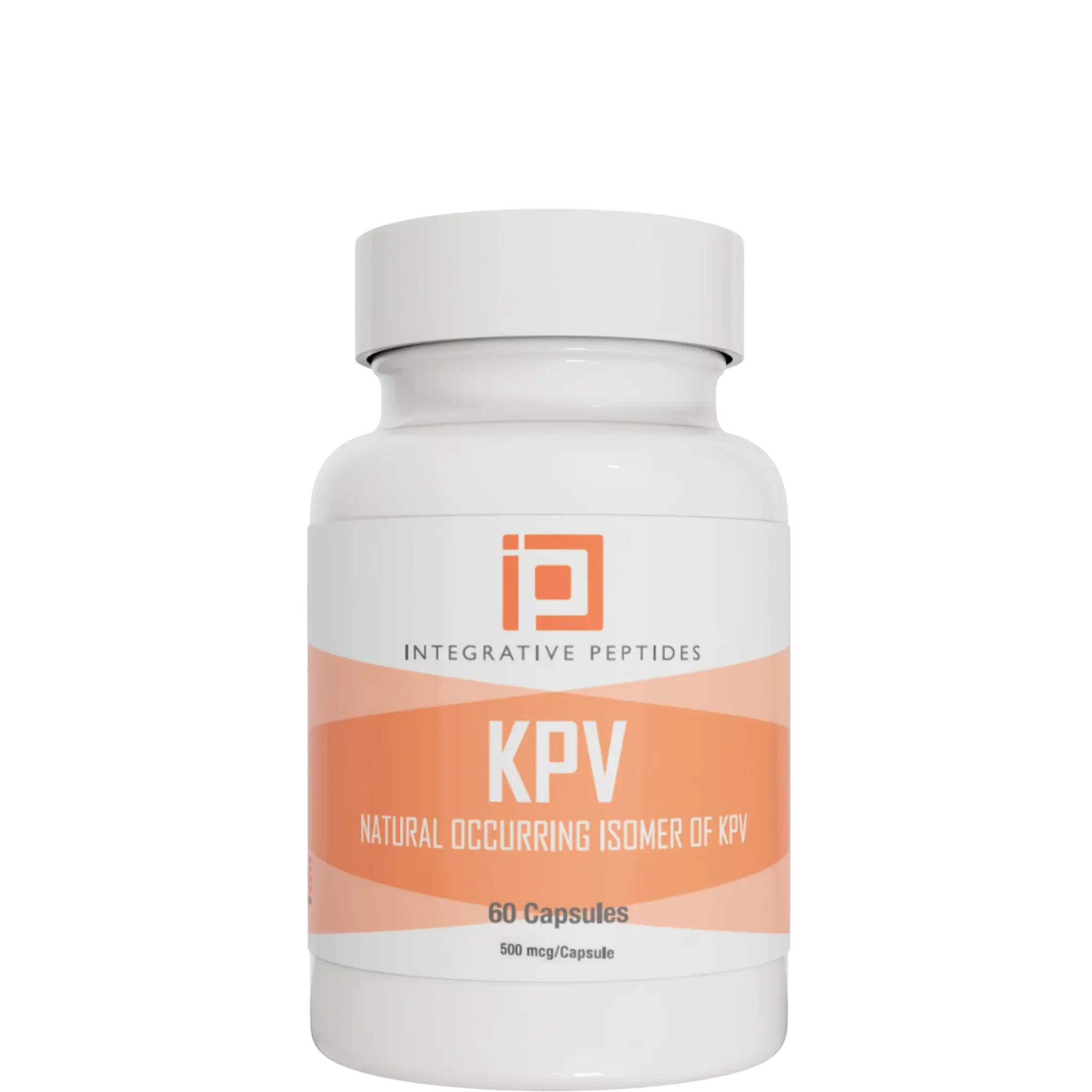
Peptide KPV Capsule
₹15,000
MRP (incl. of all taxes)
Integrative Peptides KPV Capsules deliver 500mcg of a naturally occurring acetylated and amidated isomer of KPV — a tripeptide of lysine, proline and valine — selected for structural stability and oral bioavailability.
KPV is one of the most researched anti-inflammatory peptides, supporting gut lining integrity, immune modulation, wound healing, skin health and neuroprotection.
Clinically precise. Highly bioavailable. For practitioners and informed individuals managing chronic inflammation and immune dysfunction.



Our Certification
Transformative Experience – Exceeded All Expectations!



Honest Products. Superior Quality
Our Products are made with care
 No Pesticides
 Gluten Free
 No Artificial Colors
 GMO Free
 Vegan Options
 Additive Free
 Dairy Free
 Soy Free
 Sugar Free
Building The Foundation Of Health + Nutrition
Product Description
Revolutionize Your Daily Grind with Cutting-Edge Innovation
Integrative Peptides KPV Capsules
500mcg Bioavailable KPV Tripeptide | Anti-Inflammatory · Gut · Immune · Skin · Neuroprotection
What Is It
KPV (Lysine-Proline-Valine) is a naturally occurring tripeptide — a C-terminal fragment of alpha-MSH (alpha-melanocyte stimulating hormone) — that carries its potent anti-inflammatory and immunomodulatory properties without the hormonal activity of the full peptide.
Integrative Peptides KPV Capsules use a naturally occurring acetylated and amidated isomer of KPV — a structurally modified form selected specifically for oral delivery stability. Standard peptides degrade rapidly in the gastrointestinal tract. The acetylated and amidated isomer resists enzymatic breakdown — ensuring clinically meaningful absorption and systemic bioavailability from an oral capsule.
KPV works directly at the cellular level — entering cells and targeting inflammatory pathways at the nucleus, not just at the receptor surface. This makes it uniquely effective for chronic, systemic and gut-based inflammation where surface-level anti-inflammatory approaches fall short.
This Is For You If
- You have chronic inflammation — systemic, gut-based or autoimmune-driven
- You have IBD, Crohn’s disease, ulcerative colitis or leaky gut
- You have chronic skin conditions — eczema, psoriasis or inflammatory skin disorders
- You have slow wound healing or poor tissue recovery
- You are an athlete or active individual with persistent muscle soreness and slow recovery
- You have immune dysfunction — frequent infections, slow recovery or immune hypersensitivity
- You are concerned about brain health, cognitive decline or neuroprotection
- You are working with a functional medicine practitioner on an inflammation or gut restoration protocol
- You have tried conventional anti-inflammatory approaches without adequate or lasting results
What Changes & When
Week 1–2
Reduction in acute inflammatory symptoms — pain, swelling, gut discomfort. Skin conditions begin to calm. Wound healing improves. Immune resilience starts to build.
Week 3–4
Gut lining integrity improves. Digestive symptoms reduce — bloating, urgency, discomfort. Muscle recovery speeds up. Energy improves as systemic inflammation reduces.
Week 6–8
Immune modulation stabilises. Skin conditions visibly calmer and more resilient. Cognitive clarity improves as neuroinflammation reduces. Chronic pain and inflammatory burden meaningfully lower.
3 Months+
Long-term anti-inflammatory and immune modulatory benefits established. Gut barrier integrity sustained. Tissue repair and regeneration supported consistently.
Key Actives Per Serving
Delivery format: Capsule — oral, daily
Bioavailability: Acetylated & amidated isomer selected specifically for oral stability and absorption
Fillers, artificial colours, preservatives: None
Dosage & Rationale
1–2 capsules daily or as directed by your healthcare practitioner
Why the acetylated and amidated isomer?
Standard KPV peptide is rapidly degraded by gastrointestinal proteases — making oral delivery of native KPV poorly bioavailable. The acetylated (N-terminus) and amidated (C-terminus) modifications protect the peptide from enzymatic breakdown in the gut — preserving structural integrity through the GI tract for systemic absorption. This is the critical difference between a peptide that reaches the bloodstream and one that doesn’t.
Why 500mcg?
500mcg per capsule represents a clinically relevant dose based on available KPV research. For acute inflammatory conditions or intensive protocols, 2 capsules daily (1000mcg) may be used under practitioner guidance.
Can I take more than 2 capsules?
For doses above 2 capsules daily, consult your healthcare practitioner. KPV has an excellent safety profile but higher dosing in specific conditions is best guided by a practitioner familiar with peptide therapy.
Loading period:
1–2 weeks for acute inflammatory relief · 4–6 weeks for gut lining, skin and immune modulation · 3 months for sustained systemic anti-inflammatory and neuroprotective benefit
7 Ways KPV Works
1. Anti-Inflammatory at the Cellular Level
KPV penetrates cell membranes and targets the NF-κB inflammatory pathway directly at the nucleus — suppressing pro-inflammatory cytokine production at the source. This intracellular mechanism makes KPV uniquely effective for chronic, deep-seated inflammation.
2. Immune Modulation
KPV modulates immune responses — reducing immune hypersensitivity and overactivation while supporting appropriate immune defence against infections. It balances the immune system rather than simply suppressing it.
3. Gut Lining Repair & IBD Support
KPV has demonstrated significant anti-inflammatory effects in the gut — reducing intestinal inflammation, supporting tight junction integrity and showing benefits in IBD, Crohn’s disease and colitis models. It helps seal the gut barrier from the inside.
4. Wound Healing & Tissue Regeneration
KPV promotes tissue repair and regeneration — accelerating wound healing by reducing local inflammation and supporting cellular recovery mechanisms.
5. Skin Health
By reducing inflammatory cytokines locally, KPV supports healing in inflammatory skin conditions including eczema and psoriasis. Its tissue repair properties also support overall skin resilience and recovery.
6. Muscle Recovery
KPV’s anti-inflammatory action reduces exercise-induced muscle damage and post-workout soreness — supporting faster recovery and sustained performance for athletes and active individuals.
7. Neuroprotection
Emerging research suggests KPV offers neuroprotective benefits — reducing neuroinflammation, supporting cognitive function and potentially playing a role in brain health preservation.
Safety & Interactions
Excellent safety profile — KPV is considered extremely safe with minimal reported side effects at recommended doses.
Pregnancy & lactation: Insufficient safety data for use during pregnancy or breastfeeding. Consult your healthcare practitioner before use.
Autoimmune conditions: KPV modulates immune function. Use under practitioner guidance if you are on immunosuppressant medications.
Prescription medication interactions: No known significant interactions at recommended doses. Consult your physician if on biologics or immunomodulating therapy.
Children: Not formulated for children without paediatric or practitioner guidance.
Higher dosing: Above 1000mcg daily — use under practitioner supervision only.
Disclaimer: Integrative Peptides KPV Capsules are a dietary supplement. They are not intended to diagnose, treat, cure or prevent any disease. Consult your healthcare practitioner before use, especially if you are pregnant, lactating, on prescription medication, have an autoimmune condition or are on immunosuppressant therapy.
FAQ’s
What is KPV and where does it come from naturally?
KPV (Lysine-Proline-Valine) is a naturally occurring tripeptide — a C-terminal fragment of alpha-melanocyte stimulating hormone (alpha-MSH). It is produced naturally in the body and carries the anti-inflammatory and immunomodulatory activity of alpha-MSH without its hormonal effects. As a synthetic analogue for supplementation, it is produced to match this naturally occurring sequence with modifications for oral stability.
Why is the acetylated and amidated form important?
Standard peptides are rapidly degraded by digestive enzymes in the stomach and small intestine before they can be absorbed. Acetylation of the N-terminus and amidation of the C-terminus protect the KPV peptide from this enzymatic breakdown — allowing it to survive the gastrointestinal journey and reach systemic circulation intact. Without these modifications, oral KPV bioavailability would be negligible.
How is KPV different from standard anti-inflammatory supplements like curcumin or omega-3?
Most anti-inflammatory supplements work at the receptor level or by modulating inflammatory mediators in the bloodstream. KPV works intracellularly — entering cells and directly targeting the NF-κB inflammatory signalling pathway at the nucleus. This makes it effective for chronic, treatment-resistant inflammation where conventional anti-inflammatory approaches produce limited results.
Is KPV safe?
Yes. KPV is considered extremely safe with minimal reported side effects across available research. It is a naturally occurring peptide with a well-established safety profile. As with any supplement, use under practitioner guidance for higher doses or specific medical conditions.
How long before I see results?
Acute inflammatory symptoms may improve within 1-2 weeks. Gut lining repair, skin improvement and immune modulation: 4-6 weeks. Sustained systemic anti-inflammatory and neuroprotective benefits: 3 months of consistent use. Individual response varies based on the underlying condition and dose used.
Can I take KPV with other supplements?
Yes. KPV complements broader gut restoration protocols, anti-inflammatory stacks and immune support programmes. It works well alongside probiotics, digestive enzymes, omega-3 and curcumin — addressing inflammation at a deeper cellular level while other supplements work systemically.
Is this suitable for IBD or Crohn's disease?
KPV has shown significant anti-inflammatory effects in intestinal inflammation models relevant to IBD and Crohn's disease. It is not a treatment or cure — but as a practitioner-guided adjunct in a functional medicine protocol, it may provide meaningful gut lining and anti-inflammatory support. Always use under the supervision of your gastroenterologist or functional medicine practitioner.
Reference
Transformative Experience – Exceeded All Expectations!
-
Chang CH, Tsai WC, Lin MS, Hsu YH, Pang JH. The promoting effect of pentadecapeptide BPC 157 on tendon healing involves tendon outgrowth, cell survival, and cell migration. Journal of applied physiology. 2011 Mar;110(3):774-80.
Pentadecapeptide BPC 157, composed of 15 amino acids, is a partial sequence of body protection compound (BPC) that is discovered in and isolated from human gastric juice.
-
Sikiric P, Seiwerth S, Rucman R, Turkovic B, Stancic Rokotov D, Brcic L, Sever M, Klicek R, Radic B, Drmic D, Ilic S. Stable gastric pentadecapeptide BPC 157: novel therapy in gastrointestinal tract. Current pharmaceutical design. 2011 Jun 1;17(16):1612-32.
Stable gastric pentadecapeptide BPC 157 is an anti-ulcer peptidergic agent, safe in inflammatory bowel disease clinical trials (GEPPPGKPADDAGLV, M.W. 1419, PL 14736) and wound healing, stable in human gastric juice and has no reported toxicity.
-
Ilic S, Drmic D, Franjic S, Kolenc D, Coric M, Brcic L, Klicek R, Radic B, Sever M, Djuzel V, Filipovic M. Pentadecapeptide BPC 157 and its effects on a NSAID toxicity model: diclofenac-induced gastrointestinal, liver, and encephalopathy lesions. Life sciences. 2011 Mar 14;88(11-12):535-42.
We attempted to fully antagonize the extensive toxicity caused by NSAIDs (using diclofenac as a prototype).
-
Sikiric P, Sever M, Krezic I, Vranes H, Kalogjera L, Smoday IM, Vukovic V, Oroz K, Coric L, Skoro M, Kavelj I, Zubcic S, Sikiric S, Beketic Oreskovic L, Oreskovic I, Blagaic V, Brcic K, Strbe S, Staresinic M, Boban Blagaic A, Skrtic A, Seiwerth S. New studies with stable gastric pentadecapeptide protecting gastrointestinal tract. significance of counteraction of vascular and multiorgan failure of occlusion/occlusion-like syndrome in cytoprotection/organoprotection. Inflammopharmacology. 2024 Oct;32(5):3119-3161. doi: 10.1007/s10787-024-01499-8. Epub 2024 Jul 9. PMID: 38980576.
Since the early 1990s, when Robert’s and Szabo’s cytoprotection concept had already been more than one decade old, but still not implemented in therapy, we suggest the stable gastric pentadecapeptide BPC 157 as the most relevant mediator of the cytoprotection concept.
Reviews
There are no reviews yet.